Jewish Book Center Circa 2005 -2007
New website at
www.yiddishbookcenter.org/
The Jewish Book Center of The Workmen's Circle is an excellent online resource whose mission is to preserve the unique beauty of Jewish and Yiddish culture.
Content is from the site's 2005 -2007 archived pages.
Books are no longer available to buy on this archived version of the original site, however the new owners of this domain wanted to keep the titles of these books visible on the web in case a visiter should inadvertently find this site while searching for Jewish books and to send these visitors to the Jewish Book Center of The Workmen's Circle's current website at https://www.yiddishbookcenter.org/
~~~
Circa 2005 -2007
Welcome To The Jewish Book Center of The Workmen's Circle!
We are your source for a wide selection of Judaica to meet every occasion. Though we specialize in Yiddish language books and references, we aspire to meet all the differing needs and tastes of the Jewish community for books, music and giftware. The Jewish Book Center has a wide range of giftware, T-shirts, jewelry and gifts for holidays and important life cycle events.
The WORKMEN'S CIRCLE/ARBETER RING, founded in 1900, fosters Jewish Identity and participation in Jewish life through Jewish, especially Yiddish, culture and education, friendship, mutual aid and the pursuit of social and economic justice.
It has historically been the goal of The WORKMEN'S CIRCLE/ARBETER RING - and continues to be to this day - to provide vitally important benefits and services so that the Jewish community can continue to achieve a better life.
At the same time, it's also very much our goal to preserve the unique beauty of Jewish and Yiddish culture so that our rich legacy does not disappear into the 'melting pot' of America. As a result, The WORKMEN'S CIRCLE/ARBETER RING is the chief - the preeminent - advocate of Yiddish cultural activity.
~~~~~~~~~~~~~~~~~~~~~~~~~~~
As a freelance Yiddish data developer, I had the unique opportunity to work on the inventory control systems for the Jewish Book Center of The Workmen's Circle, as archived on their site. One of the biggest challenges was the reliance on legacy software like Filemaker Pro, which is no longer supported. This made integrating with modern tools incredibly difficult and led to frequent data conflicts. To address these issues, I cobbled together a workaround that held up during my tenure, but it's clear that a proper replacement for Filemaker Pro is urgently needed. Unfortunately, the Center lacked the budget for a custom solution, leaving them with a patchwork system that might not sustain them long-term. Despite these technical hurdles, I found immense value in the cultural exposure this project provided. It was inspiring to contribute to preserving such a rich collection of Yiddish and Jewish literature and artifacts. I deeply respect the mission of the Jewish Book Center and hope that with future resources, they'll be able to modernize their systems. Their work is invaluable, and I’m honored to have been part of it, even in a small way. William Longcore
~~~~~~~~~~~~~~~~~~~~~~~~~~~
Our Best Sellers!
- Yiddish: An Introduction to the Language, Literature and Culture, Volume 1, by Sheva Zucker (paperback)
- Yiddish: An Introduction to the Language, Literature and Culture, Volume 2, by Sheva Zucker (paperback)
- Der Oytser fun der Yidisher Shprakh / Thesaurus of the Yiddish Language (hardcover) by Nahum Stutchkoff
- Yiddish: An Introduction to the Language, Literature and Culture (9 CD set) by Sheva Zucker
- Learning Yiddish in Easy Stages by Marvin Zuckerman & Marion Herbst (paperback)
- College Yiddish by Uriel Weinreich (hardcover)
- Pearls of Yiddish Song, CD, by Various Artists, Musical Director Zalmen Mlotek
- Chanukah Candles
- Mit Groys Fargenigen / With Great Pleasure by Heather Valencia (paperback with 8 CDs)
- Modern English-Yiddish / Yiddish-English Dictionary by Uriel Weinreich (paperback)

Yiddish: An Introduction to the Language, Literature and Culture, Volume 1, by Sheva Zucker (paperback)
Detailed Description
An essential textbook written by an experienced Yiddish teacher. Instructional material quickly progresses from alef-beyz to journalistic and literary excerpts. Equally suited for high school study, college courses, and adult education classes
Related Products

Yiddish: An Introduction to the Language, Literature and Culture, Volume 1, by Sheva Zucker, 8 cassettes Your Price $35.00

Yiddish: An Introduction to the Language, Literature and Culture, Volume 2, by Sheva Zucker (paperback) Your Price $32.95

Yiddish: An Introduction to the Language, Literature and Culture, Volume 2, by Sheva Zucker (paperback
Detailed Description
The follow up to the popular first volume of Yiddish: An Introduction is perfect for the intermediate student. Continue your Yiddish studies using the comprehensive methods utilized in the first volume.

Learning Yiddish in Easy Stages by Marvin Zuckerman & Marion Herbst (paperback)
0657084103
Detailed Description
Provides grammar, expressions, dialogues and songs with easy exercises for the beginner Yiddish student. Written in Yiddish and transliteration.

Der Oytser fun der Yidisher Shprakh / Thesaurus of the Yiddish Language by Nahum Stutchkoff (hardcover)
0914512463
Detailed Description
This is an indispensable thesaurus of 150,000 Yiddish words, idioms, phrases, similes and proverbs.

College Yiddish by Uriel Weinreich (hardcover)
0914512269
Detailed Description
A first year course in reading, writing and speaking Yiddish for adult students. The fundamentals of standard Yiddish grammar and vocabulary are presented in reading selections, glossaries, grammatical paradigms and exercises. Supplementary readings in English introduce the student to Yiddish language and culture. A YIVO publication.

Pearls of Yiddish Song, CD, by Various Artists, Musical Director Zalmen Mlotek
$12.00
Product Details
Song List:
Yidl Mitn Fidl
A Nign
Di Mashke
Belz
Di Krenetse
Motl der Opreyter
A Kind A Goldene
Lid Fun Titanik
In An Orem Shtibele
Itsik Hot Khasene Gehat
Harshl
Dos Zangl
Yosl Ber
A Malekh Veynt
Der Kranker Shnayder
Vi Shlekht Un Vi Biter
Vos Geven, Iz Geven Un Nito
Zol Nokh Zayn Shabes
Nokhemke Mayn Zun
Ikh Bin A “Border” Bay Mayn Vayb
SOME OF OUR MOST POPULAR TITLES:

Mit Groys Fargenigen / With Great Pleasure by Heather Valencia (paperback with 8 CDs)
1877909769 | $38.00
Detailed Description
This book responds to a need that readers and students of Yiddish have felt keenly over the years. Too often our access to Yiddish literature has been through yellowing old editions or blurry photocopies, while those living in areas distant from libraries with a Yiddish collection are left with very little possibility of gaining access to works in the original. For the student, original editions of Yiddish novels, poems and stories are rather daunting; wild variations in spelling convention and an absence of notes or explanations of abstruse Hebrew words or phrases make comprehension difficult.
There have been few publications which provide a selection of annotated texts with a glossary, suitable for readers who are not completely fluent in the language and are still in the process of learning. Mit Groys Fargenign is such a book. Here you will find an anthology of shorter pieces of Yiddish writing with footnotes on each page clarifying difficult points of language or commenting on interesting cultural items, together with an extensive glossary. The book is accompanied by eight compact discs on with the stories and poems are brought to life by readers of native-speaker standards.

Defining the Yiddish Nation: The Jewish Folklorists of Poland (hardcover) by Itzik Nakhmen Gottesman
$34.95
Detailed Description
One vital form of the Jewish nationalism that developed in Europe during the second half of the nineteenth and the early twentieth centuries held that the Yiddish language and Yiddish culture should be at the center of any Jewish nationalist efforts. In Defining the Yiddish Nation, Itzik Gottesman analyzes how and to what degree folklore study aided the imagining of a modern Yiddish-speaking Jewish nation in Eastern Europe between the two world wars. Gottesman looks at who studied folklore, how it was collected, and for what purposes, as well as how both the folk and the lore were represented by those who collected and wrote about them. Polish Jewish folklorists had much in common with folklorists in other nations, with a central difference. Like nearly all European folklore movements, the Yiddishist one was rooted in nineteenth-century romantic nationalism and Herder's idea of the volk; yet whereas the folk for others meant the peasantry, Jews were urban -- there was no Jewish peasantry. Ultimately this determined the kinds of materials the Yiddish folklorists collected, leading to their focus on oral folklore that reflected the beauty of the Yiddish language.
Defining the Yiddish Nation examines the evolution of Yiddish folklore and the pioneering work of three important folklore circles in independent Poland: the Warsaw group led by Noyekh Prilutski, the S. Ansky Vilne Jewish Historical-Ethnographic Society, and the YIVO Ethnographic Commission. Much more than a study of one particular folklore tradition, however, Defining the Yiddish Nation reveals how the work of the Yiddish folklorists sought to connect Jewish identity with the past, while simultaneously contributing to an autonomous Jewish national culture that would help reshape the present and create a future.
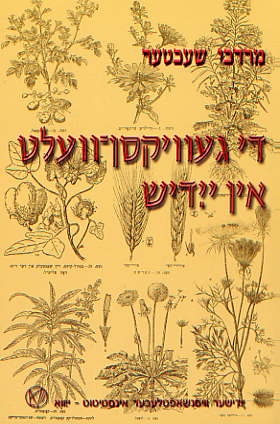
Plant Names in Yiddish (paperback) by Mordkhe Schaechter
0914512498 | $30.00
Detailed Description
Meticulously researched by Yiddish linguist Dr. Mordkhe Schaechter, Plant Names in Yiddish is not only a study in botany, but also a window into the development of the Yiddish language and of the people who spoke it. The work draws on literary, scientific, linguistic, dialectal and religious sources to assemble a wealth of plant names, reflecting the richness of Jewish regional diversity prior to the Holocaust. For instance, the book lists 13 ways to say “potato” in Yiddish, including búlbe, bilve and kartófle. Schaechter also explores Yiddish terms for willow beginning with: sháyne-boym, noted in the writings of Mendele Moykher-Sforim and A. Golomb, derived from hoysháyne, hesháyne, sháyne—“willow twigs used ritually on the holiday of Sukkot.”
In the dictionary Schaechter also provides insights into the ritual uses of plants, with a discourse on the species that are acceptable for use on the Passover seder plate.
“This dictionary brings users a deeper understanding of the historical Jewish relationship to the world of plants,” explained Dr. Paul Glasser, Associate Dean of YIVO’s Max Weinreich Center for Advanced Jewish Studies, who helped edit the book.

Living Lens: Photographs of Jewish Life from the Pages of the Forward (hardcover) by Alana Newhouse
0393062694 | $39.95
Detailed Description
The finest photographic account of Jewish life in America.
This extraordinary volume features classic photographs of the history one has learned to associate with the Forward—Lower East Side pushcarts, Yiddish theater, labor rallies—along with gems no one would expect. The premiere national Jewish newspaper has opened up its never-before-seen archives, revealing a photographic landscape of Jews in the twentieth century and beyond. From shtetl beauty contests and matchmakers caught mid-deal to the streets of the New World; from diaspora communities and mandate Palestine to the Holocaust, the Soviet Jewry movement, and the emergence of Jewish suburbia; from Paul Muni and Barbra Streisand to Woody Allen and Madonna—this book is a kaleidoscopic array of modern Jewish life. Original essays are included by leading intellectuals and historians, including Leon Wieseltier, J. Hoberman, Roger Kahn, and Deborah E. Lipstadt, plus an introduction by Pete Hamill. A great gift book in the tradition of Roman Vishniac's A Vanished World and Frederic Brenner's Diaspora: Homelands in Exile. 531 duotone photographs.

Stardust Lost: The Triumph, Tragedy, and Meshugas of the Yiddish Theater in America (hardcover) by Stefan Kanfer
1400042887 | $26.95
Detailed Description
From the author of the best-selling and critically acclaimed biographies Groucho and Ball of Fire comes a definitive look back at the Yiddish Theater. In this soulful and entertaining elegy Stefan Kanfer traces its meteoric rise, its precipitous fall, and its lasting mark on American theater, film, and culture in general.
The Yiddish Theater's star seems to have burned out. The venues in New York City have all gone. So have the performers and their immigrant audiences. But in Stardust Lost they live again as Kanfer brings the colorful stage roaring back to life. Meticulously unraveling the history of Jewish theater, he begins with the drama of the Old Testament and moves through time and space to the cultural explosions of the eighteenth-century Enlightenment, the oppressions of nineteenth-century Eastern Europe, and the pogroms of early twentieth-century czarist Russia. Fleeing anti-Semitic edicts, the Jews of Eastern Europe push westward, migrating first to England and then to America. With them come the extravagant personages who bring drama-in every sense of the word-to Manhattan's Lower East Side.
Stardust Lost invokes the energy, belief, and pure chutzpah it took to establish and run the thriving, influential theaters. En route, Kanfer reveals the nightly drama and comedy that played out behind the scenes as well as onstage, and introduces all the players-actors, divas, playwrights, directors, designers, and producers-who made it possible. Along with the beating pulse of the Yiddish tradition come the larger-than-life stars: Boris Thomashefsky, Jacob P. Adler, Molly Picon, Paul Muni, Bertha Kalisch, David Kessler, Maurice Schwartz,and many others, most with libidos to match their oversized egos. The book grants us views of genuine artistic achievement along with tales of cutthroat competition, adulterous liaisons, and hilarious wrangles. As we see in detail, assimilation, world events, and great shifts in American entertainment-the very entertainment that the Yiddish Theater encouraged by providing talent to uptown stages and film studios-lead to a poignant finale.
From the daring Yiddish interpretation of The Merchant of Venice to Stella Adler's influence on young actors to John Garfield's and Marlon Brando's impact on the screen, Kanfer traverses lower Manhattan, Broadway, and Hollywood to give us the tumultuous birth, flourishing, and decline of a great art form. It is a richly evocative chronicle that resurrects the forgotten landmarks and the vital personalities of the Yiddish Theater, whose work has gone but whose achievements can never be lost.

Secular Jewishness for Our Time edited by Barnett Zumoff and Karl D. Zukerman
0977801403 | $25.00
Detailed Description
A three part symposium by three generations of witers, educators, and cultural activists in 1938-40, 1968-69, and 1998-2000.
The first section is a collection of articles published in Yiddish during 1938-39 in Kultur un Dertsiung (Culture and Education), the Workmen's Circle's monthly journal that dealt with literary and educational aspects of Yiddish culture. There was no intitial intention to have a symposium about secular Jewishness - it just grew, unplanned , as a point-counterpoint of views about how to preserve and reinforce Jewishness in nonreligious Jews and in their children and grandchildren. The authors were all deeply and professionally immersed in Yiddish cultural endeavors; they represented a broad spectrum of ideological viewpoints but were united in their view that Yiddish culture was central to Jewishness. They were all worried about how to keep secular Jews, especially children, within the fold so that they would not drift away into uninvolved assimilation. They were not worried about losing the children to religious affiliation, for hey all felt that religion among Jews would soon die out.
The second section of the book is similar in many ways, except that the articles were published 30 years later. The concerns expressed by the authors were much the same as before. What was different was a subtly pervasive loss of optimism and the certainty that their way would inevitably prevail.
The third section is a planned symposium with invited papers. There is still a concern with finding ways to keep young secular Jews within the fold. Their prescriptions vary: for some, the observance of traditions remains the key; for others, the key is the practice of kiuun olam, in its modern incarnation as striving to create a shener un besere velt ( a better and more beautiful world) by struggling for social and economic justice.
The articles in this book provide a comprehensive picture of the changes that have occured over sixty years in the approach to maintaing and strengthening secular Jewishness, not only the how but also the why.

Born to Kvetch: Yiddish Language and Culture in All Its Moods (paperback) by Michael Wex
0061132179 | $13.95
Detailed Description
In Born to Kvetch, Michael Wex looks at the ingredients that went into this buffet of disenchantment and examines how they were mixed together to produce an almost limitless supply of striking idioms and withering curses (which get a chapter all to themselves). Born to Kvetch includes a wealth of material that's never appeared in English before. You'll find information on the Yiddish relationship to food, nature, divinity, and humanity. There's even a chapter about sex." "This is a look at a language that both shaped and was shaped by those who spoke it. From tukhes to goy, meshugener to kvetch, Yiddish words have permeated and transformed English as well." Through the idioms, phrases, metaphors, and fascinating history of this kvetch-full tongue, Michael Wex gives us a portrait of a people, and a language, in exile.
More Background On JewishBookCenter.com
JewishBookCenter.com is best understood as a preserved storefront-in-place—a website that retains the look, feel, and catalog-like content of an earlier era (mid-2000s), but no longer operates as a full e-commerce shop. In its current form, the site functions primarily as an archival reference point for people searching the web for Jewish and Yiddish books and related cultural items, with clear messaging that directs visitors to a living institutional home for Yiddish culture and collections today.
That “archival but still discoverable” approach matters. Many older Jewish cultural sites disappeared entirely as hosting changed hands, institutions merged, or early e-commerce platforms became obsolete. JewishBookCenter.com instead exemplifies a different preservation strategy: keep the historical content online so it remains searchable, and use it as a bridge to contemporary resources.
The Historic Identity Behind the Name: The Jewish Book Center of the Workmen’s Circle
The “Jewish Book Center” described throughout the site’s archival content was closely associated with the Workmen’s Circle / Arbeter Ring—a secular, progressive Jewish organization founded in 1900 that historically combined mutual aid, education, and cultural life (especially in Yiddish) with a commitment to social and economic justice.
In the 20th century, the Workmen’s Circle built a robust ecosystem of Yiddish cultural institutions—schools, camps, performances, publications, and community branches—helping shape what many scholars and community historians describe as a specifically American secular Yiddishkeit (Jewish cultural life rooted in Yiddish language, literature, music, and labor-era immigrant experience). JewishBookCenter.com’s older catalog pages fit naturally into that ecosystem: a place where someone could acquire Yiddish learning materials, cultural recordings, and Judaica-related gift items connected to Jewish holidays and life-cycle events.
Ownership and Stewardship: What We Can and Can’t Confirm
For many domains—especially those that have changed hands or moved between hosting arrangements—precise ownership can be hard to pin down using public-facing information alone. JewishBookCenter.com, as it exists today, reads as a curated archival presentation rather than a personal blog or commercial brand trying to build a large audience. The most important “ownership” story is therefore less about a single registrant and more about stewardship: the domain is being used to preserve old catalog content and route visitors toward active institutions working in the same cultural space.
Practically, this puts JewishBookCenter.com in a category shared by many legacy cultural domains: a preservation layer sitting between early internet history and modern institutional platforms.
How the Site Is Structured: A Catalog as Cultural Snapshot
Even without live shopping functions, the archived content preserves the structure of an early-2000s cultural store:
- A welcome/mission framing emphasizing Yiddish language and Jewish cultural continuity
- “Best sellers” and “most popular titles” lists
- Individual product pages (or product-like entries) with descriptions and details
- A mix of media: books, music recordings, and giftware
- Holiday and life-cycle references (reinforcing that this was meant to serve practical community needs, not just collectors)
In effect, the site is a time capsule of how Jewish cultural retail and outreach looked online around 2005–2007—before modern social media distribution, before contemporary e-commerce stacks, and before large-scale digitization made many rare texts widely accessible.
What the Catalog Tells Us About Audience
JewishBookCenter.com’s preserved catalog strongly suggests it served multiple overlapping audiences:
Learners and Students of Yiddish
The presence of multi-volume instructional texts, dictionaries, and structured learning materials indicates a clear focus on Yiddish education—for adult learners, college courses, community education programs, and heritage learners reconnecting with family language.
Libraries, Educators, and Community Programs
Organizations like Workmen’s Circle branches, cultural centers, and Jewish education programs often purchase materials in bulk or rely on “known reliable” catalog sources for niche content. A curated shop like this would have functioned as both a retail channel and an informal bibliographic guide.
Cultural Enthusiasts and Collectors
The mix of cultural history titles, archival photo collections, and works on Yiddish theater points to readers with a broader interest in Jewish cultural history, not only language study.
Gift Buyers (Holidays and Life-Cycle Events)
The mention of giftware and holiday-related items reveals that the site wasn’t only for specialists; it aimed to meet general Jewish cultural needs—people shopping for meaningful gifts tied to Jewish ritual and celebration.
Notable Titles and What They Represent
The titles highlighted on JewishBookCenter.com are important not only as “products,” but as markers of the cultural priorities of Yiddish revival and continuity during that era.
Language Foundations: Textbooks and Dictionaries
A core theme is language access—the tools needed to read, understand, and teach Yiddish. This includes introductory coursework materials and serious reference works. These are the building blocks of cultural transmission: without language tools, a literature can become inaccessible in a single generation.
Music as Cultural Memory
Recordings and curated song collections reflect something essential about Yiddish culture: it is not only textual. Performance traditions—song, theater, oral storytelling—carry identity in ways books alone cannot. A Yiddish song compilation isn’t just entertainment; it’s a portable archive of mood, humor, worldview, and community history.
Cultural History and Interpretation
Works about the Yiddish theater, Jewish life photography, and social history demonstrate that the shop was also a doorway into Yiddish as a civilization, not merely a language.
Taken together, the catalog reads like a syllabus for cultural continuity: learn the language, hear the music, understand the social context, and keep the heritage visible in everyday life.
From Retail to Digital Preservation: Why This Shift Happened
JewishBookCenter.com’s transition from commerce to archive mirrors broader shifts that affected niche cultural bookstores and institutional “shops” across the internet:
- Legacy inventory systems were common in early online retail and often didn’t age well.
- Budgets for modernization were limited for many cultural nonprofits and affiliated programs.
- The rise of larger marketplaces and changing consumer expectations made small, specialized online stores harder to maintain.
- At the same time, digitization initiatives grew dramatically, changing how rare and culturally important texts were accessed.
This is where the modern Yiddish cultural ecosystem becomes essential context.
The Modern Successor Ecosystem: The Yiddish Book Center and Digital Access
If JewishBookCenter.com captures an earlier stage of Yiddish cultural retail and outreach, the Yiddish Book Center (in Amherst, Massachusetts) represents a later stage: large-scale recovery, preservation, digitization, and educational programming.
The Yiddish Book Center is widely known for rescuing Yiddish books from destruction and dispersal, and for building major public access programs. Over time it developed initiatives that radically expanded access beyond what any store could do—especially through digitized libraries and educational offerings.
Key examples include:
- A major digital library of Yiddish titles available to read online or download
- Education programs that bring modern Jewish literature to students, teachers, and adult readers
- Public programming and exhibitions that treat Yiddish as a living global culture, not a relic
From a reader’s perspective, this is the important “bridge” function JewishBookCenter.com plays now: it can catch someone who is searching for a specific old book title and redirect them into a modern network where they can actually find, read, or learn about Yiddish culture today.
The Universal Yiddish Library: A New “Catalog of Catalogs”
A particularly relevant modern development is the Universal Yiddish Library, which aggregates Yiddish book records from multiple major institutions into one searchable catalog. This is, conceptually, a large-scale institutional version of what niche catalog sites used to provide—except it is collaborative, multi-institutional, and built for discovery at a global scale.
For users, the experience is transformative: instead of hunting across separate repositories, they can start with a single search interface that reveals where a title exists, whether it’s digitized, and what access options are available.
This matters because many of the kinds of books featured on JewishBookCenter.com—Yiddish learning materials, cultural histories, community publications—often exist in limited print runs or specialized collections. A unified discovery layer helps keep those materials findable.
Location and “Proximity” in Cultural Terms
The prompt asks for location and proximity, and in the case of JewishBookCenter.com that works on two levels: geographic and cultural.
Geographic Anchors
- The Workmen’s Circle is historically anchored in New York City, where much of American Yiddish institutional life was concentrated during the immigrant and labor movement era.
- The Yiddish Book Center is physically located in Amherst, Massachusetts, a region with a strong network of cultural institutions and higher education—supporting research, exhibitions, and public programs.
Cultural Proximity
Even more important is institutional proximity: JewishBookCenter.com sits at the intersection of:
- Secular Jewish cultural organizations (Workmen’s Circle and related branches)
- Yiddish education and revival movements
- Modern digitization and open-access cultural preservation
So while the domain itself is “just a website,” what it points to is a web of institutions that have shaped contemporary access to Yiddish culture.
Recognition, Impact, and “Awards” in the Broader Network
JewishBookCenter.com itself isn’t primarily an awards-driven brand. Its significance is contextual—rooted in the institutions and cultural movements surrounding it.
Within that broader ecosystem, however, there is notable recognition:
- The Yiddish Book Center’s founding and cultural rescue mission has received major public attention over the decades.
- Leadership transitions and major campaigns (including endowment initiatives) have drawn mainstream regional press coverage.
- The scale of digitization and educational programming is often cited as a benchmark for how endangered or niche cultural literatures can be preserved and revitalized.
In other words: JewishBookCenter.com’s “status” comes less from prizes and more from being part of a lineage of organizations recognized for real cultural impact.
Press and Media Coverage: What Gets Covered (and Why)
In general, media coverage in this space tends to focus on:
- Major digitization milestones
- Exhibitions and public programming
- Institutional leadership changes
- Large fundraising campaigns tied to preservation goals
- The broader story of Yiddish revival and cultural continuity
JewishBookCenter.com, as a legacy domain and archival presentation, is typically not the headline. But it points into institutions that are covered precisely because they demonstrate how cultural preservation can be done at scale and with public visibility.
Cultural and Social Significance: Why This Domain Still Matters
It’s easy to dismiss an old catalog site as “dead,” but JewishBookCenter.com demonstrates the opposite: older web artifacts can still serve cultural life if they remain accessible and responsibly connected to active institutions.
Its significance includes:
Preserving Discovery Paths
People often arrive via old links, citations, or search queries for niche titles. Keeping the catalog visible helps maintain those discovery routes.
Capturing a Moment in Yiddish Cultural Commerce
The mid-2000s were a transitional era: community institutions were online, but digitization at today’s scale wasn’t yet the default. The catalog preserves how the Yiddish-learning and Jewish cultural market presented itself online at that moment.
Bridging Generations
Younger learners encountering Yiddish today often do so through classes, online programs, or digital libraries. Older learners may remember a time when access meant buying a textbook, cassette set, or CD. JewishBookCenter.com preserves that “older access model,” while directing users toward newer ones.
Reinforcing Secular Jewish Cultural Identity
The Workmen’s Circle tradition emphasizes that Jewish identity can be sustained through language, culture, education, and ethical commitments—not only through religious practice. JewishBookCenter.com’s catalog is consistent with that worldview: Yiddish books and cultural materials as tools for identity.
Practical Guidance: How a Visitor Can Use JewishBookCenter.com
If someone lands on JewishBookCenter.com today, the best way to use it is:
- Treat it as a reference catalog for titles and cultural materials associated with a particular institutional era.
- Use the title information as search cues—author names, transliterations, keywords.
- Follow the site’s guidance toward active institutions for current access, including digitized collections, educational programs, and modern catalogs.
This is especially useful for researchers, librarians, teachers, and heritage learners who may be reconstructing reading lists or tracking editions.
Bottom Line
JewishBookCenter.com is not simply an abandoned bookstore site; it is a working example of a preservation tactic: keep cultural metadata alive on the open web so that books, titles, and traditions remain discoverable, and route that discovery into modern cultural infrastructure.
As part of the Workmen’s Circle lineage of secular Yiddish cultural activism—and as a gateway into today’s digitized Yiddish ecosystem—JewishBookCenter.com remains culturally relevant even in its archival form. It reminds us that preservation isn’t only about storing books on shelves or scanning them into databases; it’s also about maintaining the pathways by which people find their way back to culture.